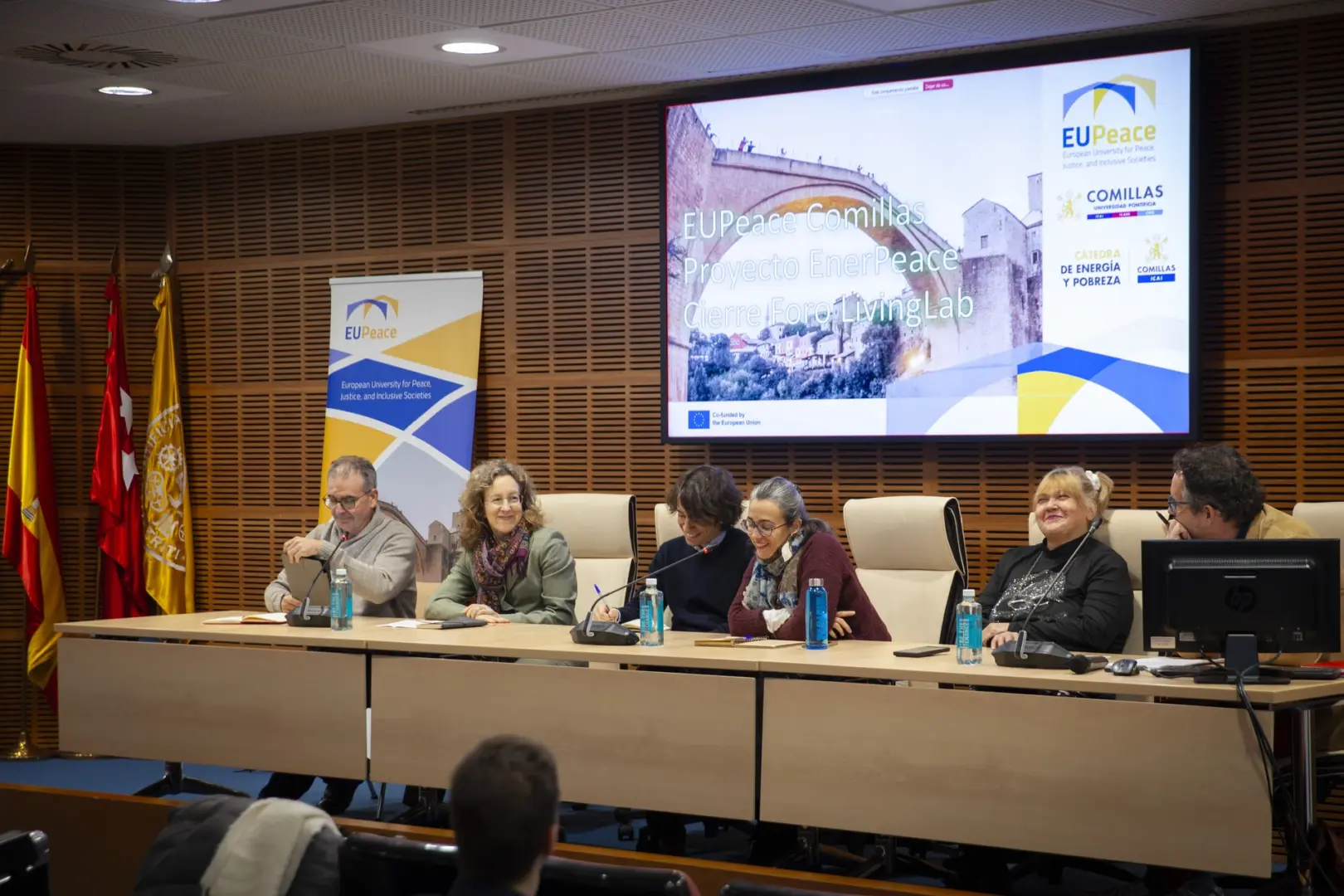
On 27 November, the closing event of the Living Lab EnerPeace took place, an initiative promoted by the ICAI Chair in Energy and Poverty in collaboration with EUPeace. During the meeting, the results of the Energy Poverty Indicators Report in Spain 2024 were presented, prepared for the fifth consecutive year by the Chair in Energy and Poverty at Comillas Pontifical University, offering key data on the situation of households in Spain.
Living Labs function as dynamic spaces for creative learning, co-creation and collective action, where experts, institutions, organisations and citizens work together to address complex problems such as energy poverty. This approach combines scientific evidence with practical experiences and the voices of those directly affected, enabling data-driven and participatory solutions.
This Living Peace Lab is part of the broader effort led by EUPeace at Comillas within Work Package 7 (Societal Dialogue), which aims to foster citizen engagement, co-creation and transdisciplinary collaboration around major societal challenges. As one of the flagship initiatives of WP7, the EnerPeace Living Lab has served as a pilot model for strengthening dialogue between academia, public institutions, industry, civil society and vulnerable communities—placing energy poverty at the centre of a European agenda for peacebuilding, social cohesion and ecological transition.
Multi-stakeholder dialogue: from data to solutions
The session was introduced by José Carlos Romero, coordinator of the Living Lab EnerPeace and also coordinator of the Chair in Energy and Poverty, and Teresa Morales, Director of EUPeace at Comillas, who highlighted the value of the Living Lab as a forum for multidisciplinary collaboration, capable of integrating research, professional experience and citizen voices. They also emphasised the importance of framing these projects within the European EUPeace alliance to enhance their scope, impact and sustainability.
Representatives from MITECO, Endesa, Universidad Autónoma de Madrid, EAPN Madrid and vulnerable groups participated in the roundtable. Participants stressed the importance of combining quantitative data with real-life stories, which allows the identification of common ground and the design of more effective policies. One of the key messages was the need to avoid stigmatising people in poverty and to recognise that, beyond sectoral differences, there is a common goal: to protect vulnerable people and move towards sustainable and fair solutions.


Key insights from research and collaboration
During the meeting, it was highlighted that energy poverty in Spain remains a structural problem:
- 5% of households spend disproportionately on energy compared with their income.
- Almost 18% of families report that they cannot keep their homes at an adequate temperature in winter.
- Around one-third of rental households are in energy poverty, with figures far exceeding the incidence in the general population.
These findings confirm the urgency of more effective public policies and interventions designed with scientific evidence and real experience.
Towards a permanent participation space
Attendees stressed the importance of consolidating the Living Lab as a stable forum for collaboration, allowing the systematisation of findings, improved data access, simplified procedures and the reduction of the gap between regulations and reality. This includes creating consultation and advisory mechanisms that directly incorporate the voices of those experiencing energy poverty.
Mercedes Saiz, a participant affected by energy poverty, closed the event by reminding attendees of the need to ‘shield vulnerability and care for the vulnerable’, reinforcing the importance of continuing to investigate the multidimensional causes of the problem.
A journey through the Living Lab results
- First session: identification of challenges and initial proposals for the future National Strategy against Energy Poverty (ENPE 2025–2030).
- Second session: participatory design of a Social Table to accompany the ENPE, systematising contributions for MITECO.
- Third session: development of protocols to protect households from supply cuts, prioritising measures based on evidence and real experience.
- Fourth session: online session for making concrete proposals within the framework of the public consultation on the ENPE 2025–2030 draft.
Conclusion
The Living Lab EnerPeace demonstrates how rigorous research can translate into effective social action when combined with citizen participation and multi-stakeholder dialogue.
The data from the Energy Poverty Indicators Report 2024 not only document the magnitude and characteristics of the problem but also serve as a basis for designing more inclusive, sustainable and reality-adapted public policies.