
The EUPeace Doctoral Network offers structured support through international networking and regularly updated course and training offerings. This includes:
- Virtual trainings and courses organised by EUPeace Graduate Schools
- Virtual and in-person exchange and training formats with experts from the EUPeace Alliance
- Spaces for self-organised exchanges built around thematic focal points defined by Doctoral Network members.
The European University for Peace, Justice, and Inclusive Societies, EUPeace, evolves out of nine core member universities that have committed their strategic international outlook in teaching, research and administration in higher education to foster a peaceful, just, and inclusive European landscape, at various levels. For this, we explicitly address all sciences and research fields, from the humanities and social sciences to the natural and life sciences as well as engineering.
Please see our current Call to join the Doctoral Network!
The EUPeace Doctoral Network and the Doctoral Groups of the Research Hubs
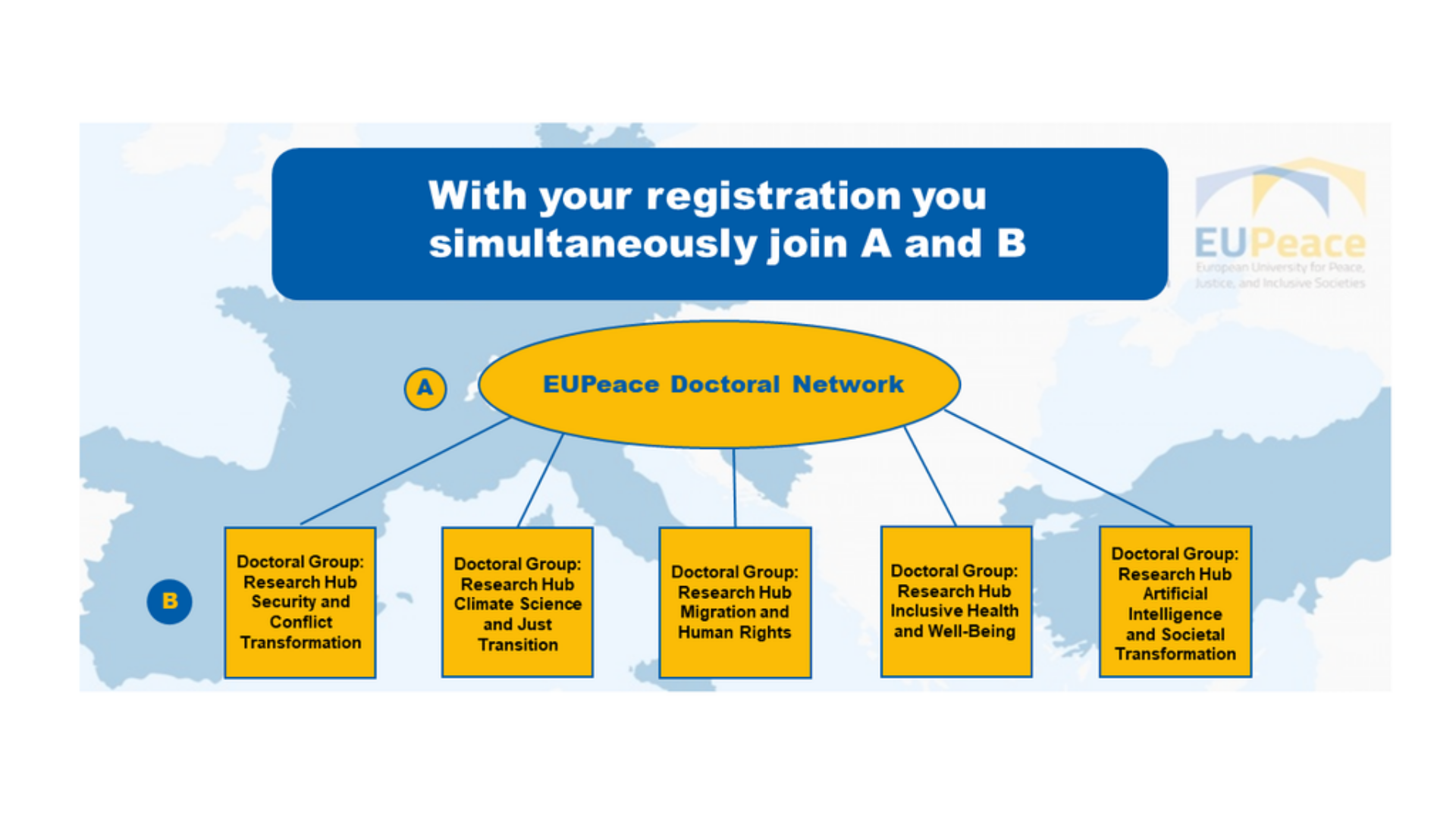
The EUPeace Doctoral Network is organised in the framework of the EUPeace Research Hubs. This means that all members of the EUPeace Doctoral Network are integrated in a) a joint network for doctoral candidates within the EUPeace Alliance (see visualisation below). Simultaneously, all Doctoral Network members join b) a Doctoral Group of one of the five EUPeace Research Hubs:

Contact

Our current call
The EUPeace Research Hubs


The Research Hubs mobilise existing academic strengths of the EUPeace Alliance and foster collaboration in all subject areas in order to create excellent inter- and transdisciplinary research and academic capacity for curriculum development and academic advancement in peace, justice, and inclusive societies.
General Information
Who can register: All doctoral candidates pursuing their doctorate at one of the EUPeace Alliance member sites. All EUPeace Doctoral Mobility Grant recipients are also members of the Doctoral Network.
How to register: Complete the registration form, indicating your Research Hub selection.
Main benefits:
- Structured doctoral training within the support network of the EUPeace Alliance
- International networking opportunities with other doctoral candidates within an interdisciplinary network with a high degree of diversity
- Access to courses and events provided by Graduate schools of the Alliance members
- Enhancement of both general soft skills and thematic skills
- Collaboration with Research Hubs and participation in research-based teaching activities
- Thematic support from Research Hubs in the form of regular conferences, seminars and thematic courses
- Yearly participation in additional activities and in-person events
- Information on and support for doing a Cotutelle within the Alliance institutions.
Duration of membership: The membership in the Doctoral Network ends when members actively decide to leave the network, or finish their PhD.
Start date: There will be a yearly kick-off meeting for the new cohort of Doctoral Network members, it is however possible to join the network anytime.
Universities from the EUPeace Alliance participating in the EUPeace Doctoral Network: Germany: Marburg University (UMR); Germany: Justus Liebig University Giessen (JLU); France: University of Limoges (UNILIM); Italy: University of Calabria (UNICAL); Spain: Comillas Pontifical University (COMILLAS); Czechia: University of West Bohemia in Pilsen (UWB); Bosnia and Herzegovina: University of Mostar (SUM); Türkiye: Çukurova University (CU); Bosnia and Herzegovina: University of Sarajevo (UNSA).
Selection process: There is no selection process for joining the Doctoral Network.
Contact: For further information regarding the EUPeace Doctoral Network, please contact the EUPeace Work Package 6 team: eupeace-doctoral-network@uni-marburg.de.
Course Offers
This course list encompasses fixed-date courses as well as continuously available courses that are offered by the, EUPeace Research Hubs, Graduate Schools, as well as further doctoral support structures within the EUPeace Alliance. The courses are predominantly virtual. The course list will be continuously updated and information on how to register for the respective fixed-date courses will be sent via the Doctoral Network’s email list.
Psychological Perspectives on Sustainable Consumer Behaviour: Key Theories and Models
Date: 22 January 2026, 14:30-16:30 (CET)
Offered by: Irene Garnelo, Comillas Pontifical University
Target group: All doctoral network members
Description: Promoting sustainable consumer behaviour is one of the most pressing challenges of our time, yet the well-documented attitude–behaviour gap shows that positive intentions do not always translate into consistent action. The session Psychological Perspectives on Sustainable Consumer Behaviour: Key Theories and Models will examine how psychological mechanisms can help explain and encourage sustainable behaviours. For instance, research has shown that motivations play a central role in sustainable decision making, as individuals who are intrinsically motivated to make sustainable choices (i.e., not driven by an external reward) are significantly more likely to adopt sustainable habits and maintaining them overtime. Identity is also a powerful driver, with studies demonstrating that when sustainability becomes part of someone’s self-concept, such as identifying as a “green consumer”, their behaviours align more strongly with sustainable practices. Emotions add another important dimension, as positive emotions such as feelings of pride and satisfaction have been shown to reinforce positive habits like recycling, while negative emotions such as guilt about environmental harm can also act as a trigger for change. Overall, the session will provide insights into how a deeper understanding of the psychological factors driving sustainable practices can help promote sustainable consumer behaviour at both individual and collective levels, helping to bridge the existing attitude-behaviour gap.
Trajectories of Human-Centred Development in International Institutions
Date: 29 January 2026, 14:30-16:30 (CET)
Offered by: Tadashi Hirai, Comillas Pontifical University
Target group: All doctoral network members
Description: This lecture explores the evolution of UN development thinking, moving from an emphasis on economic growth to human-centred approaches. Early frameworks, influenced by colonial legacies and the Bretton Woods institutions, prioritized post-war economic expansion, while the 1960s saw the inclusion of social welfare measures beyond income. The 1970s Basic Needs approach focused on well-being, giving rise to holistic indicators such as the Physical Quality of Life Index. In the 1990s, the UNDP’s Human Development paradigm, led by Mahbub ul Haq and Amartya Sen, introduced the Human Development Index (HDI), shifting attention from GDP to health, education, and living standards. Human development, unlike growth-centric models, emphasizes equality, intrinsic needs, and participation. The lecture questions whether human development represents a new approach, tracing its roots in earlier models and its application across nations. It also connects development to sustainability—from the 1972 Stockholm Conference to the 2015 SDGs—highlighting the challenges of integrating environmental and justice considerations into global metrics.
GGS-Workshop: Introduction to Machine Learning
Date: 26 – 28 October 2026 and 10 – 11 November 2026, 9.00 – 14:30 (CET)
Offered by: Giessen Graduate Centre for Social Sciences, Business, Economics and Law (GGS), Speaker: Dr Tobias Keller
Target group: All Doctoral Network members
Description: After this in-person workshop, participants understand the basic concepts and typical process of machine learning and how it enables artificial intelligence systems. On the basis of examples from practice and research, participants will learn to think like data scientists, and to ask the right questions. They will also learn to apply and evaluate algorithms for supervised and unsupervised machine learning tasks using the open source software KNIME, which does not require programming knowledge. Since there will be no need to learn a programming language during the course, more time will be allocated to understanding the algorithms on an intuitive, non-formal level. The course consists of lectures to build the theoretical background as well as hands-on tutorials and exercises using the machine learning software KNIME. Participants will learn by examples and exercises from the instructor’s experience in research and practice. Hands-on tutorials and exercises will make up about 40 per cent of the course time. Students will complete those using their own computers. Please see the preparation requirements below for a list of software that needs to be installed to that end. The exercises will be based on exemplary datasets that will be provided to the participants before the course.
Only remaining places can be allocated. Please register by 16 October 2026 via e-mail to info@ggs.uni-giessen.de. More information is available here.
GGS-Workshop: Introduction to Python
Date: 4 – 6 November 2026, 9.00 – 15.00 (CET)
Offered by: Giessen Graduate Centre for Social Sciences, Business, Economics and Law (GGS), Speaker: Dr Tobias Keller
Target group: All Doctoral Network members
Description: In this in-person workshop, participants will learn Python fundamentals for real data work, build reproducible project environments, use git for version control, and get hands-on experience with AI-assisted coding via GitHub Copilot.
The course covers the following core topics:
• Python basics – variables, types, control flow, functions, classes, scripts
• Data structures – lists, dicts, and tabular data with pandas
• Project structure – packages, imports, pyproject.toml
• Tooling – Integrated Development Environment (IDE), dependency management and virtual environments
• Best practices from Software Development – testing, logging, version control with git, AI-assisted development
Hands-on tutorials and exercises will make up about 90 per cent of the course time. Participants will complete those using their own computers. Please see the preparation requirements below for a list of software that needs to be installed to that end. The exercises will be based on exemplary datasets that will be provided to the participants before the course. Only remaining places can be allocated. Please register by 2 November 2026 via e-mail to info@ggs.uni-giessen.de. More information is available here.
GGS-Workshop: Writing Academic Journal Articles in English
Date: 12 & 13 November 2026, 9.00 – 16.00 (CET)
Offered by: Giessen Graduate Centre for Social Sciences, Business, Economics and Law (GGS), Speaker: Dennis Friedrichsen, PhD
Target group: All Doctoral Network members
Description: The objective of this in-person workshop is to introduce academic writing strategies for publications in peer-reviewed journals. This is a hands-on course that will enable participants to begin writing their own articles based on solid structure that many journals will recognize. The workshop is particularly well-suited for early-career researchers who perhaps have not yet developed professional confidence and/or who have perhaps not yet published their first article. The workshop will provide information on topics such as writing structure, writing coherence, academic style, and tips for editing one’s own writing. While some theory will be presented, the workshop will place a strong emphasis on participant and lecturer interactions, thus aiding in the practical development of competences. Only remaining places can be allocated. Please register by 2 November 2026 via e-mail to info@ggs.uni-giessen.de. More information is available here.
PCMO@GGS-Workshop: Third Party Funding for First Time Applicants
Date: 20 November 2026, 9.30 – 16.00 (CET)
Offered by: Verena Graulich, Justus Liebig University Giessen
Target group: Doctoral Network members who wish to apply for research funding in Germany
Description: The ability to acquire research grants is one of the main competencies required if you strive for a professorship in Germany. Combining informative input and practical elements, this online workshop will provide you with an overview on prominent funders and funding programmes in Germany for early career researchers. We will discuss the structure and elements of proposals along the example of the DFG (Deutsche Forschungsgemeinschaft – German Research Foundation) research grant and explore what to consider when putting them into writing. We will also present you with helpful resources on grant writing and discuss the DFG review process with Prof. Meinhardt (DFG Liaison Officer) who will share practical advice for grant writing in a Q&A session. Afterwards, you will be able to understand the structure and requirements of grant writing and the meaning of third party funding for the development of your career and for appointment processes. Only remaining places can be allocated. Please register by 6 November 2026 via e-mail to info@ggs.uni-giessen.de. More information is available here.
[Online] PCMO@GGS Lecture: Transformation der qualitativen Datenanalyse mit AI
Date: 20 November 2026, 9.00 – 12.00
Offered by: Giessen Graduate Centre for Social Sciences, Business, Economics and Law (GGS), Speaker: Dr. Thorsten Dresing
Target group: All Doctoral Network members
Description: This online lecture in German will deal with transformation of qualitative data analysis with AI. Qualitative social research is on the verge of a major transformation: Since September 2022, AI has not only enabled significantly faster transcription (+50%), but—with the widespread availability of large language models (LLMs) such as ChatGPT—has also opened up new perspectives for the analysis of qualitative data. The presentation offers a critical analysis of this development and highlights specific applications—ranging from AI-assisted data preparation to methodologically sound prompt engineering. “Hybrid interpretation” introduces an innovative approach that integrates various LLMs into a systematic dialogue while upholding methodological quality standards. Using practical examples, the potential and limitations of AI integration are demonstrated, and participants discuss together how this is bringing about lasting changes in qualitative research practice. Please register until 16 November 2026 via e-mail to postdocs@ggs.uni-giessen.de. More information is available here.
[Online] PCMO@GGS-Workshop: How to Publish Strategically and Boost Your Publication Profile
Date: 27 November 2026, 9.00 – 15.30 (CET)
Offered by: Giessen Graduate Centre for Social Sciences, Business, Economics and Law (GGS), Speaker: Jakob Horstman
Target group: All Doctoral Network members
Description: In this online workshop, participants can expect to:
• learn how to plan an individual publication strategy in line with their career goals.
• receive a comprehensive overview of how publication processes work in both journal and book publishing.
• learn about practical aspects of academic publishing such as peer review processes, the pros and cons of co-authorship, usage rights, Open Access, and many more.
• learn how to increase their public profile as an academic author via suitable online platforms.
This practice-oriented workshop develops the foundations of a successful academic publishing strategy for early career scholars and helps the participants in building a highly visible publication portfolio. The participants will learn how to assess their research in the context of the scientific publishing market and develop a publication strategy in line with their individual career goals.
The workshop covers a wide range of topics, from choosing the most appropriate publication format and applying the most salient selection criteria for target publishers to the management of review processes and self-marketing in an impact-oriented academic environment. A separate part of the course is dedicated to help the participants create and maintain a lively publication profile through the usage of suitable online platforms.
Further practical modules deal with the creation of optimized titles and abstracts for both books and journal articles as well as with the advantages and disadvantages of co-authorship. It also provides an overview of the most important aspects of plagiarism and usage rights, as relevant e.g. for the ‘recycling’ of dissertation chapters towards journal articles or contributions to edited collections. Finally, the importance of Impact Factors, Open Access and other facets of the digital dimension of academic publishing will be addressed. Only remaining places can be allocated. Please register by 18 November 2026 via e-mail to postdocs@ggs.uni-giessen.de. More information is available here.
Keynote: Forget the Work-Life Balance – Tailor Your Life. Or: The 7 Secrets of People Who Make It All Work
Date: 10 November 2026, 12.00 – 13.30 (CET)
Offered by: Justus-Liebig-University Giessen, Speaker: Prof Dr Daniela Elsner (Business-Life Coaching, Executive Coaching, Solution-Focused Brief Therapy, Career & Leadership Trainings)
Target group: All Doctoral Network members
Description: What is the secret of people who successfully manage different tasks and roles in their lives without constantly feeling like they are stuck in a hamster wheel? What is their key to resilience in challenging situations? How do they juggle it all without burning out?
In this interactive online talk, Daniela Elsner, business-life coach, psychotherapist (HPr.G), professor of learning and teaching, mother of three and author of the book “Ausgebalanced” (Gabal Verlag) shares her personal and scientific knowledge on how successful people juggle “it all”. Her first recommendation: “Forget the work-life balance, tailor your life!”
This talk is aimed at all those who want to acquire new patterns of action and strengthen their resilience to successfully deal with their different professional and private challenges. Participants will critically examine the current model of work-life-balance and understand that a balanced life is a very individual perception, which starts with self-responsibility and the right attitude towards individual life goals. Participants will learn about an alternative model for work-life design and its underlying principles to achieve more satisfaction with one’s (working) life by explicitly applying certain resilience strategies. Resgistration by November 2, 2026, via email to info@ggs.uni-giessen.de. Please note: The coaching sessions offered are only available to members of JLU or UMR. More information is available here.
MOOC Research integrity in scientific professions
Link: https://www.fun-mooc.fr/en/courses/research-integrity-scientific-professions/
Offered by: Doctoral Office, University of Limoges
Target group: All doctoral network members