






Sometimes, the most powerful moments at a conference are the ones nobody planned for. At the EUPeace Teaching Europe Conference 2025 in Limoges, one such moment came when sign language was used on an equal footing with spoken communication. For many in the room, it reframed something fundamental: how easily we accept that certain ways of expressing knowledge count more than others.
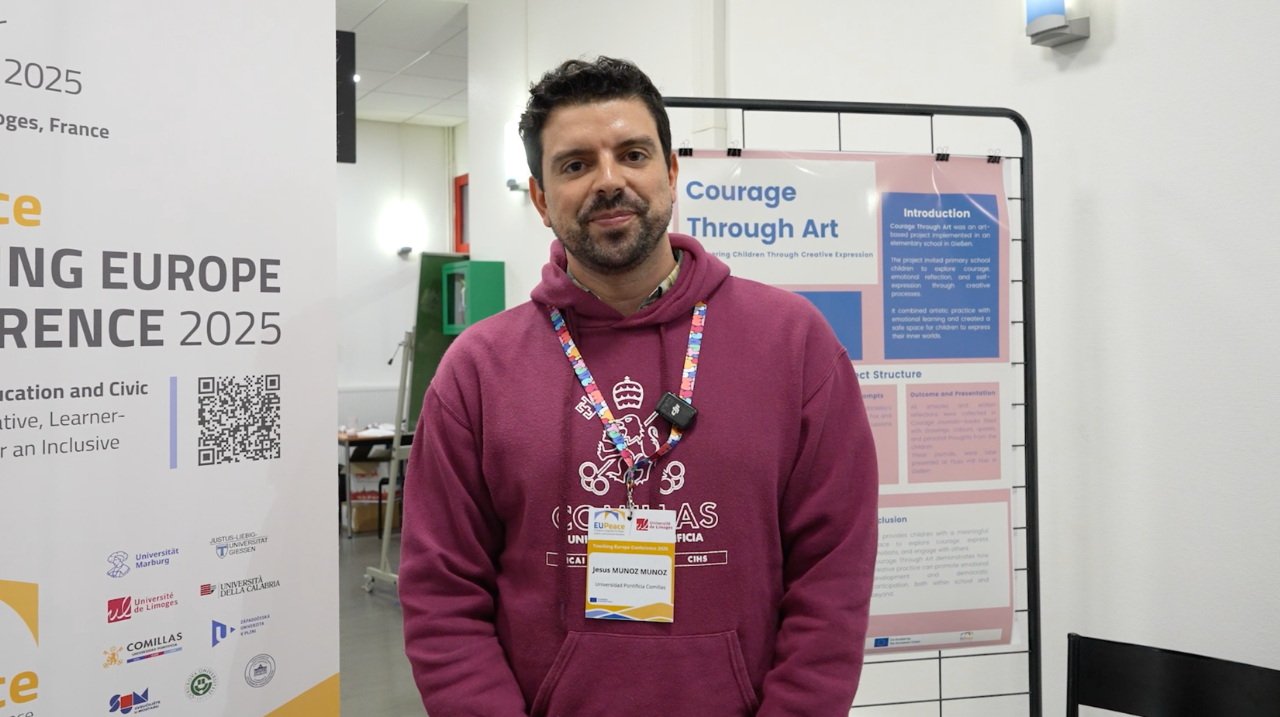
For Jesús Muñoz Muñoz, an early-career PhD researcher and lecturer in bioethics at Comillas Pontifical University, the experience cut to the heart of his work. It made visible the implicit hierarchies that shape every classroom – and it showed that accessibility is not something we add on top of good teaching. It is part of what makes teaching just in the first place.
Contact
When justice becomes tangible
That conviction runs through Jesús’s research and teaching. In applied ethics, he argues, justice cannot remain an abstract principle to be discussed and examined from a distance. It has to shape the actual conditions under which people learn, speak and participate – or it remains incomplete.
This is exactly what he set out to test in practice. Three Jesuit universities – Comillas Pontifical University (Spain), Universidad del Pacífico (Peru), and Universidad Iberoamericana Puebla (Mexico) – developed a Collaborative Online International Learning (COIL) module that asks students to examine justice through different philosophical traditions – and then apply those ideas to real social challenges in their own countries, from inequality to corruption. Rather than keeping ethical reflection separate from action, the module treats the transition from theory to situated intervention as its central learning outcome.
Teaching across borders without barriers
Jesús presented this work at the Teaching Europe Conference, where it prompted lively discussion among colleagues from across Europe. Questions focused on assessment design, scalability and the challenge of measuring long-term impact on students’ moral reasoning – the kind of critical exchange that sharpened the project’s methodology and confirmed its relevance beyond a single institutional context.
What makes the COIL format particularly significant for teacher education is its accessibility. Unlike physical mobility programmes, which often come with financial and logistical barriers, COIL embeds international collaboration into regular coursework. For future teachers, this means gaining first-hand experience of navigating cultural diversity – not as an optional extra, but as a routine part of their professional preparation.
A competence that is no longer optional
For Jesús, this shift matters because the classrooms of tomorrow demand it. Concepts like dignity, health and responsibility are understood and experienced differently across cultural contexts. Educators who lack intercultural awareness – however well-intentioned – risk reproducing the very exclusion they set out to prevent.
Building that awareness, he argues, requires more than exposure to different perspectives. It requires structured, guided encounters where disagreement is possible and where students learn to reason across difference rather than retreat from it. This is where ethical reflection and intercultural competence meet – and where teacher education has the most ground to cover.
The challenge ahead
Perhaps the most pressing question Jesús raised in Limoges is one that many teacher educators will recognise: how to sustain spaces for genuine critical dialogue in an increasingly polarised world. Not by imposing a particular view, and not by retreating into neutrality – but by facilitating structured disagreement with rigour and mutual respect.
It is precisely this kind of exchange that the Teaching Europe Conference was designed to enable – a space where early-career researchers and experienced educators come together to explore what inclusive, justice-oriented teaching looks like in practice. Jesús’s contribution showed that the conversation is not only alive, but growing.
A starting point for students
Experiences like Jesús’s show that international collaboration does not have to wait until after graduation. Whether through COIL modules, virtual exchanges or cross-border projects, students in teacher education and beyond can begin developing intercultural competence during their studies – often without leaving their home university.
EUPeace offers a range of opportunities for students who want to explore this: from joint courses and the Virtual European Exchange Programme (VEEP) to soft skills courses and the EUPeace Course Repository. If the questions raised in this article resonate with you, these are good places to start.
The Teaching Europe Conference is EUPeace’s annual forum for teacher educators, researchers and students working on innovative, learner-centred teaching for an inclusive and just Europe. The next edition is currently being planned – details will be published on the EUPeace events page.