








The EUPeace Doctoral Network offers structured support through international networking and regularly updated course and training offerings. This includes:
- Virtual trainings and courses organised by EUPeace Graduate Schools
- Virtual and in-person exchange and training formats with experts from the EUPeace Alliance
- Spaces for self-organised exchanges built around thematic focal points defined by Doctoral Network members.
The European University for Peace, Justice, and Inclusive Societies, EUPeace, evolves out of nine core member universities that have committed their strategic international outlook in teaching, research and administration in higher education to foster a peaceful, just, and inclusive European landscape, at various levels. For this, we explicitly address all sciences and research fields, from the humanities and social sciences to the natural and life sciences as well as engineering.
Contact
View the details of our open call
 © Rolf K. Wegst
About the EUPeace Doctoral Network and the Doctoral Groups of the Research Hubs
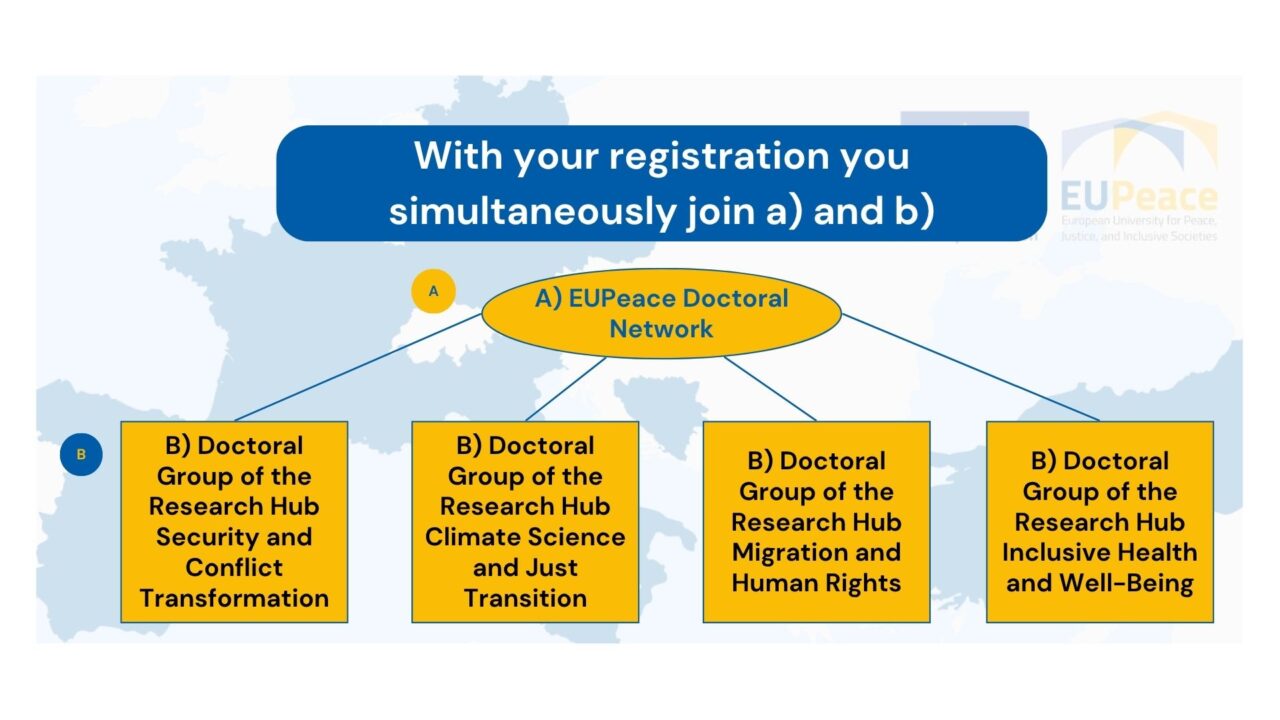
The EUPeace Doctoral Network is organised in the framework of the EUPeace Research Hubs. This means that all members of the EUPeace Doctoral Network are integrated in a) a joint network for doctoral candidates within the EUPeace Alliance (see visualisation below). Simultaneously, all Doctoral Network members join b) a Doctoral Group of one of the four EUPeace Research Hubs:
The EUPeace Research Hubs
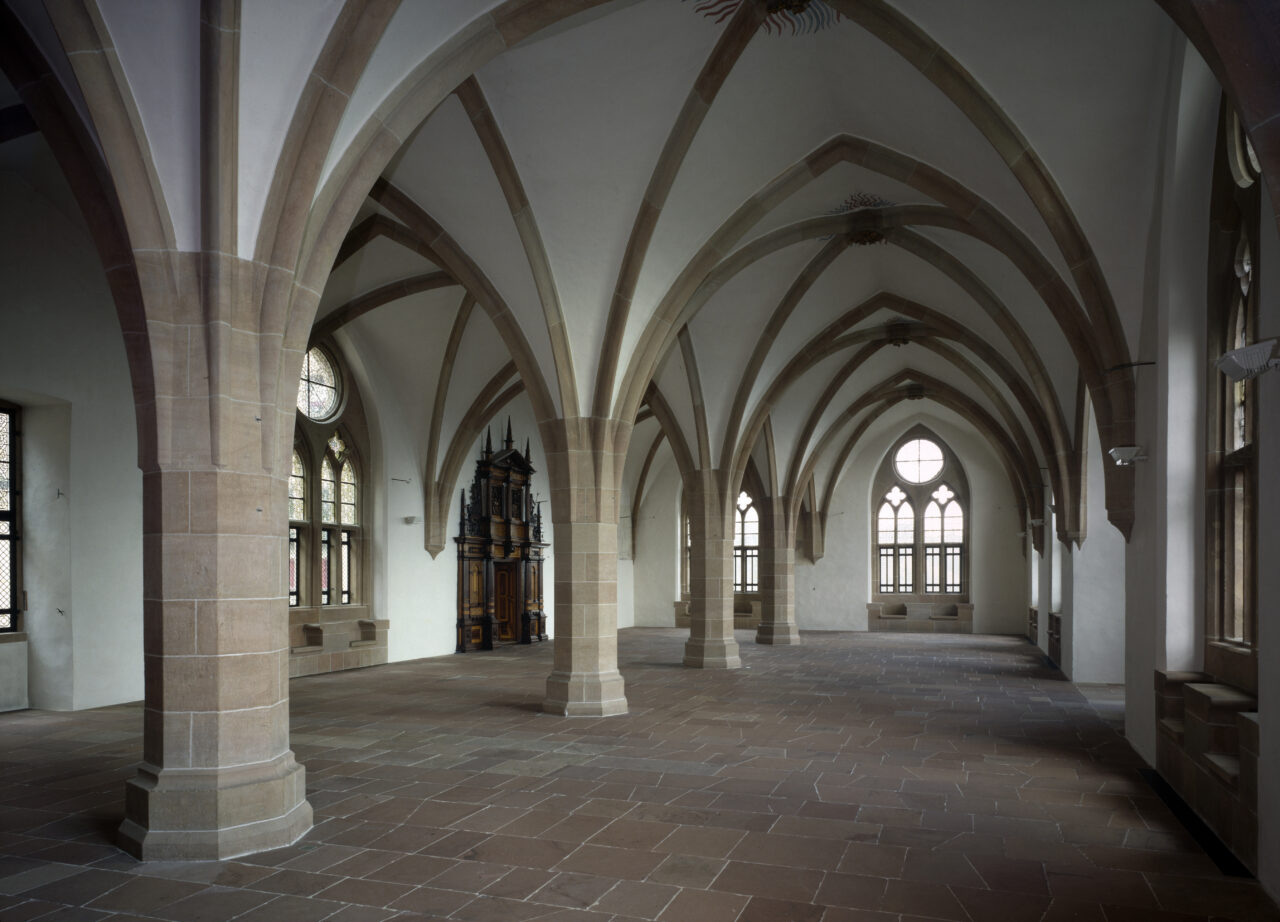 © Jan Gloc / Bildarchiv Foto Marburg
 © Ronny Friedrich via Adobe Stock
 © Rolf K. Wegst
 © Rolf K. Wegst
The Research Hubs mobilise existing academic strengths of the EUPeace Alliance and foster collaboration in all subject areas in order to create excellent inter- and transdisciplinary research and academic capacity for curriculum development and academic advancement in peace, justice, and inclusive societies.
Course Offers
This course list encompasses fixed-date courses as well as continuously available courses that are offered by the, EUPeace Research Hubs, Graduate Schools, as well as further doctoral support structures within the EUPeace Alliance. The courses are predominantly virtual. The course list will be continuously updated and information on how to register for the respective fixed-date courses will be sent via the Doctoral Network’s email list.
Fixed-date Courses
Psychological Perspectives on Sustainable Consumer Behaviour: Key Theories and Models
- Date: 22 January 2026, 14:30-16:30 (CET)
- Offered by: Irene Garnelo, Comillas Pontifical University
- Target group: All doctoral network members
- Description: Promoting sustainable consumer behaviour is one of the most pressing challenges of our time, yet the well-documented attitude–behaviour gap shows that positive intentions do not always translate into consistent action. The session Psychological Perspectives on Sustainable Consumer Behaviour: Key Theories and Models will examine how psychological mechanisms can help explain and encourage sustainable behaviours. For instance, research has shown that motivations play a central role in sustainable decision making, as individuals who are intrinsically motivated to make sustainable choices (i.e., not driven by an external reward) are significantly more likely to adopt sustainable habits and maintaining them overtime. Identity is also a powerful driver, with studies demonstrating that when sustainability becomes part of someone’s self-concept, such as identifying as a “green consumer”, their behaviours align more strongly with sustainable practices. Emotions add another important dimension, as positive emotions such as feelings of pride and satisfaction have been shown to reinforce positive habits like recycling, while negative emotions such as guilt about environmental harm can also act as a trigger for change. Overall, the session will provide insights into how a deeper understanding of the psychological factors driving sustainable practices can help promote sustainable consumer behaviour at both individual and collective levels, helping to bridge the existing attitude-behaviour gap.
Trajectories of Human-Centred Development in International Institutions
- Date: 29 January 2026, 14:30-16:30 (CET)
- Offered by: Tadashi Hirai, Comillas Pontifical University
- Target group: All doctoral network members
- Description: This lecture explores the evolution of UN development thinking, moving from an emphasis on economic growth to human-centred approaches. Early frameworks, influenced by colonial legacies and the Bretton Woods institutions, prioritized post-war economic expansion, while the 1960s saw the inclusion of social welfare measures beyond income. The 1970s Basic Needs approach focused on well-being, giving rise to holistic indicators such as the Physical Quality of Life Index. In the 1990s, the UNDP’s Human Development paradigm, led by Mahbub ul Haq and Amartya Sen, introduced the Human Development Index (HDI), shifting attention from GDP to health, education, and living standards. Human development, unlike growth-centric models, emphasizes equality, intrinsic needs, and participation. The lecture questions whether human development represents a new approach, tracing its roots in earlier models and its application across nations. It also connects development to sustainability—from the 1972 Stockholm Conference to the 2015 SDGs—highlighting the challenges of integrating environmental and justice considerations into global metrics.
Continuously Available Courses
MOOC Research integrity in scientific professions
- Link: https://www.fun-mooc.fr/en/courses/research-integrity-scientific-professions/
- Offered by: Doctoral Office, University of Limoges
- Target group: All doctoral network members
General Information
Who can register: All doctoral candidates enrolled and/or employed at one of the EUPeace Alliance member sites. All EUPeace Doctoral Mobility Grant recipients are also members of the Doctoral Network.
How to register: Complete the registration form, indicating your Research Hub selection.
Main benefits:
- Structured doctoral training within the support network of the EUPeace Alliance
- International networking opportunities with other doctoral candidates within an interdisciplinary network with a high degree of diversity
- Access to courses and events provided by Graduate schools of the Alliance members
- Enhancement of both general soft skills and thematic skills
- Collaboration with Research Hubs and participation in research-based teaching activities
- Thematic support from Research Hubs in the form of regular conferences, seminars and thematic courses
- Yearly participation in additional activities and in-person events
- Information on and support for doing a Cotutelle within the Alliance institutions.
Duration of membership: The membership in the Doctoral Network ends when members actively decide to leave the network, or finish their PhD.
Start date: There will be a yearly kick-off meeting for the new cohort of Doctoral Network members, it is however possible to join the network anytime.
Universities from the EUPeace Alliance participating in the EUPeace Doctoral Network: Germany: Marburg University (UMR); Germany: Justus Liebig University Giessen (JLU); France: University of Limoges (UNILIM); Italy: University of Calabria (UNICAL); Spain: Comillas Pontifical University (COMILLAS); Czechia: University of West Bohemia in Pilsen (UWB); Bosnia and Herzegovina: University of Mostar (SUM); Türkiye: Çukurova University (CU); Bosnia and Herzegovina: University of Sarajevo (UNSA).
Selection process: There is no selection process for joining the Doctoral Network.
Contact: For further information regarding the EUPeace Doctoral Network, please contact the EUPeace Work Package 6 team: eupeace-doctoral-network@uni-marburg.de.